
Friday, August 15, 2014
Chicken Day
Just came in from lighting the scalding tank. The tank gets lit a 5am. But chicken day starts the day before. Yesterday George setup all of the equipment, and Sharon put the finishing touches on the labels and made sure all of the pick-ups are scheduled.


Thursday, July 10, 2014
Hay 2014
It's that time of year again. The time of year that I remember how wrong NOAA weather forecasts are, and how the NOAA models can't even seem to predict weather less than 48 hours out. Yep, it's hay season. Our hay inventory is low this year and it won't get better. The hay was cut late and while that gave us a higher tonnage, it also means that that it's doubtful we'll get second cuttings. And with the weather predictions being less than helpful, I'm glad that I switched out the original rollers on the mower to the B&D rollers. We've been able to cut hay and get it baled a little on the high moisture side, but up in about 48 hours. This week we should be done with hay, but we'll have to see what the weather does.

Friday, June 27, 2014
I'm a little be behind on keeping up so I'll try to run down where we are and what we're doing.
The dwarfs all look good and have been fastened to their trellis.


The dwarfs all look good and have been fastened to their trellis.
And with the rain that we've had in such a short amount of time, they're well watered in! We had some hail and that took a few branches off of one of the rows of the dwarfs. Strange, but it was an inside row. Not any other row, just one.
I went to an IPM field day the end of last week in Eastern Iowa. It was very good. The more time spent scouting and learning from others is extremely valuable. It's one thing to see disease and insect problems in a book or on on-line, but it's much different to try to look for it on leaves and fruit in an orchard and then come up with a plan to deal with it.
Our current orchard activity is removing all of the apples from the trees and using cloths pins to correct crotch angles on the small upper branches.
The orchard has been pretty clean with limited pest pressure so far. The cedar apple rust is back, but not as extensive as last year so far. I didn't treat for it this year, but with two years of infection data, we'll make sure we come up with a plan going into next year. We did get sun scald on
our trees that have lighter colored bark. I don't have a good picture of it, but the problem comes in the winter from the sun warming the bark enough to allow water to flow, and then freezing. It kills the bark on the south facing side of the trees. We'll have to see how they handle it over the next year or so. The other issue we had was the hail. We pulled all of the apples off of the trees again this year, but before we pulled them, the hail damaged most of the apples and left them with dents in them.
That would be a real bummer to have the crop damaged by hail, but then I guess that it's just another one of those things that you can't control.
Hopefully this coming week will be dry enough to start cutting hay in ernest. We got a small cutting off of the back of the farm, but the bulk of the hay is still waiting for its first cut. It has to be great for the bees on the farm. The alfalfa is in bloom and every pollinator in the county must be able to smell it, if they can smell. If you want to know what heaven's going to smell like, just stand down wind of the hay field with the alfalfa blooming. And then when it's fresh cut, and then again when it's drying. What awesome smells.
Last weekend we processed chickens. They turned out really nice again. It's great to be able to offer such a high quality product. Feel free to stop out any time and take a look at how we raise the chickens. I think you'll appreciate the difference and see why we take such pride in how they're raised and processed. It takes a lot of management, but as with most things on the farm its a matter of managing and working within the variables of the natural environment vs controlling the variables. One example that always amazes me is that the chickens don't get eaten by predators. Having pens that they can get into at night for shelter is enough to keep the predation to a minimum while allowing them to roam during the day. The other extreme would be to keep them always penned up or to put them in a building where we would totally control that variable. The chickens are extremely labor intensive, so there's always a debate about next year.
Finally, the high tunnel raspberries are HUGE this year. I should have pruned them back early in their growth, but I didn't and now we're paying the price by having canes that are ridiculous. The raspberries not in the high tunnel are about 1/4 the height. It will be interesting to see how the berry production is on these canes.
Tuesday, May 27, 2014
Dwarf Apples
Dwarf apples generally won't stand on their own. And in NW Iowa where the wind blows hard most days, that means some type of support system is required for dwarf apples.
 We started out by measuring, measuring some more, and finally measuring a little more, to determine where the new rows for the orchard would be placed. Then we sunk some posts that are about 10' out of the ground. Then we sunk some short posts into the ground and left about a foot out of the ground to act as a strainer against the long posts. Next we ran a strait line between the posts and measured out for flagging where the trees would go. We decided to go 4' between trees. That gives each tree 2' of branch growth. Finally we used our Bobcat skid loader to drill the holes. Then, stretching high tensile between the posts, we were ready to put the new trees in. Once the trees were in we ran irrigation lines and emitters to the trees and finally we strung the high tensile with strainers and line posts. It took about 2 days to plant the trees and get the waterline and the trellis system up. We did end up with about 10 trees off the trellis in the last row. Those we ended up attaching to pieces of rebar. Eventually these will be attached to either trellis, or we'll switch to better posts.
Friday, May 16, 2014
Plant garden on Mothers Day?
With the temperature on the farm below freezing for more than 4 hours last night, the Mothers Day date didn't hold this year. And it's supposed to be colder tonight. Frost is one thing, but freezing temps for that long are something all together different. Our apple trees for the most part are at 1/2" green tip and tight cluster. For tight cluster, at 27F for 30min a 10% loss is expected. At about 6' high (where our weather station sits) we were down below 29 for about an hour, but our weather station in the high tunnel said it hit 27F and that is one foot off the ground. Chances are we had 27F for quite a while at ground level.
Wednesday, May 14, 2014
Twins
We had a couple more calves. Unfortunately it was from the same cow, and we haven't had very good luck with twins. So the standard process now is to take the calf that isn't sticking with the cow and put it in the barn. That means bottle feeding, but it's not so bad. Both twins are doing fine.

Friday, May 2, 2014
First Calf of 2014
We moved the cows, bull and last years calves down to the back 9 yesterday. It took a little time and persistence to get them through the gates and different parts of the pastures, but they made it. Not quite sure what I was thinking having the bull down there with them though. If he got to work this early we'd have calves in Feb. and that isn't for me.
We checked on the cows this morning and bingo! our first calf was on the ground looking healthy and fit. We got him ear tagged and banded.
 Handling the cattle always has a sense of excitement about it. There's always that little bit of extra caution when you're moving them and they're all excited, kicking up their heals (literally) and running to new grass, that they could forget themselves and plow you down. Then there's the excitement of ear tagging and banding while mamma wants to get between you and her calf. They have a protection instinct in them that you want to see, just not too much.

We checked on the cows this morning and bingo! our first calf was on the ground looking healthy and fit. We got him ear tagged and banded.
Friday, April 25, 2014
Cedar Apple Rust - Scouting Help Needed
Do you live in NW Iowa and have an Eastern Red-cedar tree, or more specifically a Juniperus virginians, near you? We could use your help! Last year most of our orchard was infected with cedar apple rust (CAR). It comes from participating in the life cycle of the fungi called Gymnosporangium juniperi-virginianae which as you can tell by the name of the fungi lives on Juniperus virginians - the Eastern Red-cedar. Iowa has a lot of Eastern Red-cedar trees and they even grow in road ditches. Cedar apple rust requires two hosts to complete its lifecycle. The cedar tree is the primary host and an apple tree, or several other types of trees as secondary hosts.

We are managing our orchard with Integrated Pest Management (more on that in another post). Basically we will utilize all of the methods, information, scientific models and predictors that we can to avoid applying pesticides. In the case of CAR, it has a pretty specific environment that it lives in, and has to be released from the cedar tree to infect the apple orchard.
So this is where you can help. If you have a cedar tree in your yard or somewhere that you pass everyday, take a look and see if you see any galls on it that look similar to this:
 If you do, those are probably the fungi galls that causes CAR. Drop us an email and let us know.
Then if you see the galls turn into this:
Definitely drop us an email, because this is when they produce horns that disperse the spores in an attempt to transfer it to its other host, possibly an apple tree.
Thanks for the help.
2014 Read or Not
The farm has been coming out of hibernation the past few weeks and so the activity around the farm has really picked up. We've been getting the water lines reconnected so that we can move the cows out of their winter paddock, water the raspberries in the high tunnel, and water the apple trees once they need it. Sharon picked up the broiler chicks this morning too, so you know that things are really about to get busy.
Monday, November 11, 2013
Raspberries Done for 2013
We opened the high tunnel to let the raspberries go dormant for the winter. It's supposed to get down into the single digits F over the next couple of days. My plan is to try to keep the high tunnel open for most of the winter, but I'm not sure if that is a good idea or not. My hope is that the high tunnel can handle being open when we get high wind storms during the winter. I don't want to close the high tunnel and have the temps popping up and triggering the raspberries to break their dormancy too early, or not be dormant enough and damaging the raspberries with freeze thaw. Time will tell I guess. One thing is for sure. We won't have any greens out of the high tunnel this year.
Sunday, November 3, 2013
Berries Too Cold
I think I may have let the raspberries get too cold one night last week. When I got up in the morning it was 27F at about 5am. I didn't check to see how long it was down that low, but I figured it had to be quite a while. I've only run the heater for a few nights this fall, so I turned on the heater in the high tunnel, but I think it was too late. The quality of the ripe berries is poor. I'm hoping that the berries that are still unripe will ripen well, but we won't know until we get some sun on the plants and see how they move forward. Guess we'll know as the week goes on.
Wednesday, October 2, 2013
Raspberry Production Year 1
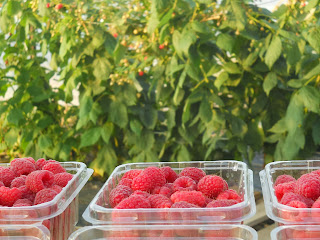
The raspberry plants are producing really well. We had thought that the first year production would be light, but it turns out that our production is really good for our first year. So much so that we are getting 4 to 5 pints a day, not including what we're eating (which is substantial).

Wednesday, August 28, 2013
Raspberry Heat Stress White Drupelet Disorder
We're currently seeing heat stress in our raspberries. It started showing up even before it got extremely hot, but it was limited to one here and there. But the past couple of days we've seen it really hitting the Heritage variety of raspberries. What we're seeing are some white drupes within the drupelet.


- Drupe - The fleshy fruit with a single seed. In a raspberry or blackberry, it would be each of the individual tiny round balls of fruit that make up a cluster in what is considered the berry.
- Drupelet - The individual drupes that in composite are considered the berry on plants such as raspberry or blackberry.
So what we're seeing is called White Drupelet Disorder. Looking that up I found that it can be caused by a handful of issues, but one being excessive heat.
Imagine that? A plant that's in a greenhouse, even with its sides open and the end-wall door wide open, would show signs of heat stress in NW Iowa from this past week. The high tunnel weather station showed a hight temp of 109F two days ago. I'd say that qualifies as excessive heat. The Heritage raspberry variety is more susceptible to the disorder, and the variety showing the most symptoms is Heritage, but the others that are producing right now are showing it here and there too. They don't taste any different, but they aren't very pretty.
Sunday, August 11, 2013
Final Chicken Day 2013
The second day of 2013 chicken processing went great. Our customers are a big part of making it a lot of fun. Thanks to all of our customers and we look forward to seeing you again next year. Enjoy your chickens!
Friday, August 9, 2013
Chicken Days August 2013 Today
Today starts the last chickens for 2013. We caught the chickens last night and I started the scalder this morning. So far so good. The scalder didn't go out like the July chicken day so I'm hoping that all will be smooth sailing.
Saturday, July 13, 2013
July Chickens Day 2
Day one went awesome! The process went so smooth that we were amazed ourselves. The only issue we had was that the scalder flame blew out from the wind shortly after I lit the scalder. I knew I had a problem when I smelled the LP as I crossed the lane. It really didn't set us back, we just heated water on the stove and on another outside burner, then combined it into the sclading pot and we were ready to go. Hopefully we run as smoothly today.
Friday, July 12, 2013
July Chicken Days
Today and tomorrow we process the July batch of chickens. We setup for processing yesterday and we're trying a couple new additions to our processing. We're always looking for ways to make the process better.
Monday, July 8, 2013
.5 GPH Emitters
Today we added additional emitters to the orchard waterline for each tree. Each of the emitters puts out .5 gal of water per hour. Based on putting an inch of water on the roots of each tree based on the number of trees per acre etc we determined that a single .5 gal emitter won't come close to putting out enough water if we don't get any rain. So we added the emitters. It was the perfect job for the day. With the outside temperature at about 90F, the water that sprayed out of the irrigation line from punching holes to push the emitters into was a nice way to keep cool. We finished the south side of the orchard. Tomorrow we'll finish up the north side.
Tuesday, July 2, 2013
Cedar Apple Rust (CAR)
I was out scouting the orchard today and noticed a few things of note. A lot of the trees have settled into the soil and have pulled their rubber bands free from their trunks. Another is that the grass seed is sprouting, but it is very, very thin. I'm sure we'll be over seeding this fall. A couple of the apples that we left on a few trees are maturing. The apples are mainly on the Wealthy apple trees.
And finally I noticed that several varieties of trees have cedar apple rust (CAR) which is a fungal disease produced by juniper trees, also known as red cedars in IA.
We'll definitely have to keep an eye on the CAR to see if it is a yearly problem or just one that is an every once in a while thing. My neighbor has a very nice grove of cedars a couple miles from the orchard, and since the spores can travel 2 - 5 miles, it may be something that we just have to manage.
 |
| Cedar Apple Rust (CAR) |
 |
| Wealthy Apple |
Friday, June 28, 2013
Cutting Hay Crop 2013
We cut hay a couple of weeks ago and it was really nice stuff. We only cut enough to get a rack or two of small squares up before the rain, and then hoped for dry weather to be able to take a big cutting and get the hay crop in for the year. This week NOAA said we would have a long stretch of dry weather so we cut a lot of hay. The orchard/alfalfa/clover mix looks great and based on the height and volume while cutting, it has to be 2-3 tons to the acre. Cutting it was slow going with the cutter-conditioner but I guess that's the price I'll gladly pay for such a bumper crop of hay. Today we'll spread the hay out to get rid of the wet spots, and if we're lucky we'll rake it up tomorrow and bale.
 |
| Grass Hay |
 |
| Tom with Orchard/Alfalfa/Clover Mix |
Subscribe to:
Posts (Atom)
