

Wednesday, May 14, 2014
Twins
We had a couple more calves. Unfortunately it was from the same cow, and we haven't had very good luck with twins. So the standard process now is to take the calf that isn't sticking with the cow and put it in the barn. That means bottle feeding, but it's not so bad. Both twins are doing fine.


Friday, May 2, 2014
First Calf of 2014
We moved the cows, bull and last years calves down to the back 9 yesterday. It took a little time and persistence to get them through the gates and different parts of the pastures, but they made it. Not quite sure what I was thinking having the bull down there with them though. If he got to work this early we'd have calves in Feb. and that isn't for me.
We checked on the cows this morning and bingo! our first calf was on the ground looking healthy and fit. We got him ear tagged and banded.
 Handling the cattle always has a sense of excitement about it. There's always that little bit of extra caution when you're moving them and they're all excited, kicking up their heals (literally) and running to new grass, that they could forget themselves and plow you down. Then there's the excitement of ear tagging and banding while mamma wants to get between you and her calf. They have a protection instinct in them that you want to see, just not too much.

We checked on the cows this morning and bingo! our first calf was on the ground looking healthy and fit. We got him ear tagged and banded.
Friday, April 25, 2014
Cedar Apple Rust - Scouting Help Needed
Do you live in NW Iowa and have an Eastern Red-cedar tree, or more specifically a Juniperus virginians, near you? We could use your help! Last year most of our orchard was infected with cedar apple rust (CAR). It comes from participating in the life cycle of the fungi called Gymnosporangium juniperi-virginianae which as you can tell by the name of the fungi lives on Juniperus virginians - the Eastern Red-cedar. Iowa has a lot of Eastern Red-cedar trees and they even grow in road ditches. Cedar apple rust requires two hosts to complete its lifecycle. The cedar tree is the primary host and an apple tree, or several other types of trees as secondary hosts.

We are managing our orchard with Integrated Pest Management (more on that in another post). Basically we will utilize all of the methods, information, scientific models and predictors that we can to avoid applying pesticides. In the case of CAR, it has a pretty specific environment that it lives in, and has to be released from the cedar tree to infect the apple orchard.
So this is where you can help. If you have a cedar tree in your yard or somewhere that you pass everyday, take a look and see if you see any galls on it that look similar to this:
 If you do, those are probably the fungi galls that causes CAR. Drop us an email and let us know.
Then if you see the galls turn into this:
Definitely drop us an email, because this is when they produce horns that disperse the spores in an attempt to transfer it to its other host, possibly an apple tree.
Thanks for the help.
2014 Read or Not
The farm has been coming out of hibernation the past few weeks and so the activity around the farm has really picked up. We've been getting the water lines reconnected so that we can move the cows out of their winter paddock, water the raspberries in the high tunnel, and water the apple trees once they need it. Sharon picked up the broiler chicks this morning too, so you know that things are really about to get busy.
Monday, November 11, 2013
Raspberries Done for 2013
We opened the high tunnel to let the raspberries go dormant for the winter. It's supposed to get down into the single digits F over the next couple of days. My plan is to try to keep the high tunnel open for most of the winter, but I'm not sure if that is a good idea or not. My hope is that the high tunnel can handle being open when we get high wind storms during the winter. I don't want to close the high tunnel and have the temps popping up and triggering the raspberries to break their dormancy too early, or not be dormant enough and damaging the raspberries with freeze thaw. Time will tell I guess. One thing is for sure. We won't have any greens out of the high tunnel this year.
Sunday, November 3, 2013
Berries Too Cold
I think I may have let the raspberries get too cold one night last week. When I got up in the morning it was 27F at about 5am. I didn't check to see how long it was down that low, but I figured it had to be quite a while. I've only run the heater for a few nights this fall, so I turned on the heater in the high tunnel, but I think it was too late. The quality of the ripe berries is poor. I'm hoping that the berries that are still unripe will ripen well, but we won't know until we get some sun on the plants and see how they move forward. Guess we'll know as the week goes on.
Wednesday, October 2, 2013
Raspberry Production Year 1
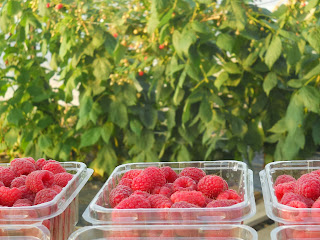
The raspberry plants are producing really well. We had thought that the first year production would be light, but it turns out that our production is really good for our first year. So much so that we are getting 4 to 5 pints a day, not including what we're eating (which is substantial).

Subscribe to:
Posts (Atom)
